There is a particular moment at the cinema when all financial judgement seems to leave the building. You've already paid for your ticket, you're standing beneath an enormous illuminated menu, and a bag of popped corn — of all things — has begun to look like an entirely reasonable purchase.
I've spent a good part of my working life trying to understand why people buy things. And yet, like most of us, I had never really questioned the popcorn. I assumed the price was simply what happens when a business has you trapped in a foyer with twenty minutes to spare and very little competition.
That explanation isn't entirely ridiculous. But it's incomplete. Because the more interesting question is not why the popcorn is expensive. It's why cinema operators would rather charge more for something optional than recover every available dollar through the admission ticket.
THE PRODUCT THEY DIDN'T WANT.
Popcorn wasn't always part of a respectable night at the pictures. Early movie palaces worked hard to resemble theatres: plush interiors, carefully presented foyers, an environment that suggested an occasion rather than a snack break. As Smithsonian Magazine's history of cinema popcorn explains, operators worried about the mess and noise, while vendors sold popcorn outside the doors.
The Great Depression changed the calculation. Movies offered relatively inexpensive escape; popcorn was an affordable treat. What once appeared to cheapen the experience began to offer cinemas another way to earn money from customers already coming through the door. The enduring partnership was not a stroke of branding genius dreamed up in a boardroom. It was a business discovering that a supposedly secondary product could help support its central attraction.
FOLLOW THE MONEY.
Admission revenue isn't the same thing as money a cinema gets to keep. Distributors and studios share in box-office takings under agreements that vary by film and by its stage of release. Concessions have their own economics, and it is worth separating those two streams rather than treating every dollar a patron spends as identical.
For a concrete example, Cinemark's 2025 annual filing reports US$1.5447 billion in admissions revenue and US$1.2272 billion in concession revenue, out of US$3.115 billion of total revenue. That means concession sales accounted for about 39.4% of the company's revenue that year. Not profit — revenue. An important distinction if we're going to follow the money rather than merely make popcorn sound scandalous.
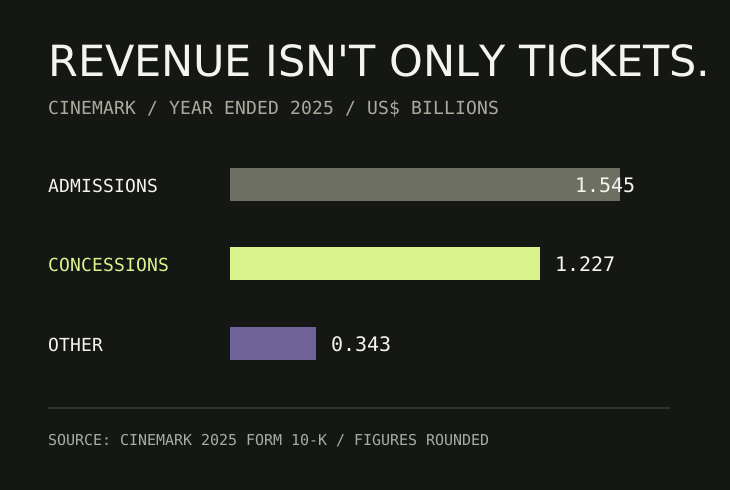
There are costs attached to operating the concessions business, of course. The same filing lists US$240.5 million of concession supplies expense, but supplies alone are not the complete cost of selling popcorn. Staff, premises, equipment and other operating expenses still matter. Our point is narrower, and better supported: the concession counter is not an incidental sideline to the cinema's revenue model.
WHY NOT CHARGE MORE FOR THE TICKET?
Here is where the story gets more interesting. Two people can buy tickets to the same film and place very different values on the surrounding experience. One wants the movie and nothing else. The other wants the popcorn, a drink, perhaps a few extras. Charge everyone a higher ticket price and some price-sensitive customers may stay home. Keep admission relatively accessible and allow optional purchases, and customers who value the extras can choose to spend more.
Economists call this a form of metering price discrimination. A Stanford Graduate School of Business working paper by Wesley Hartmann and Richard Gil analysed concession sales data from Spanish cinemas and found evidence that concession purchases help reveal how much customers value attending the cinema. The pricing structure can create different outcomes for different customers; it isn't proof that every person is better off, or that every popcorn price is justified.
One person buys the movie. Another buys the whole night out. Both walk through the same door.
That's what makes the concession stand such an interesting invisible product. It is both a retail counter and a mechanism for letting customers signal how much they value a particular experience.
THE HABIT HIDING IN THE DARK.
Then there is the other peculiar part of this relationship: we don't always buy popcorn because we've decided, consciously and carefully, that we'd like some popcorn. Sometimes we buy it because we're at the movies.
In a 2011 behavioural study by David Neal, Wendy Wood and colleagues, researchers gave cinema-goers fresh or stale popcorn. People with strong habits of eating popcorn at the movies consumed similar amounts of both. Those without the habit reacted more strongly to how the popcorn tasted. The setting itself had become a cue for behaviour.
Think about that the next time you find yourself ordering the usual bucket before you've even checked whether you're hungry. The product is doing more than satisfying an appetite. It has become part of the ritual of going to the cinema: the rustle of the carton, the smell in the foyer, the first handful during the trailers.
EVERY BUSINESS HAS A POPCORN STAND.
Once I started looking at the concession counter this way, I began noticing similar structures everywhere. A printer and its ink. A razor and its replacement blades. A relatively accessible entry product, followed by something customers choose — or need — to buy later. These examples don't all work identically, but they share a useful question: is the visible product the complete business, or merely the beginning of the relationship?
The answer matters beyond marketing. It changes what we notice as customers, and the questions we ought to ask as business owners. A headline price may describe the transaction in front of us without describing the economic system behind it.
So yes, cinema popcorn can be expensive. But that price is not the entire story. The more interesting revelation is how a product that once sat outside the theatre found its way into the middle of the business model — and then into our habits.
Next time you're standing in front of the concession stand, you might see a bucket of popcorn. I suspect I'll see a very peculiar business model. Which is slightly annoying, because it means I can no longer enjoy a movie without conducting an informal audit of the foyer.
Look closer.
RESEARCH NOTES.
Primary and supporting references
- Cinemark Holdings — 2025 Form 10-K. Revenue by business line and concession supplies expenses; amounts are reported in US dollars.
- Hartmann & Gil — Why Does Popcorn Cost So Much at the Movies? Stanford GSB working paper, 2008, on metering price discrimination.
- Smithsonian Magazine — Why Do We Eat Popcorn at the Movies? Natasha Geiling, 2013, on the history of popcorn in cinemas.
- Neal, Wood, Wu & Kurlander — The Pull of the Past. Personality and Social Psychology Bulletin, 2011; published abstract indexed by PubMed.
Editorial note: The figures quoted above describe Cinemark's 2025 consolidated business. They are not presented as universal cinema margins. This research companion is independently written and should not be mistaken for a transcript of the documentary.